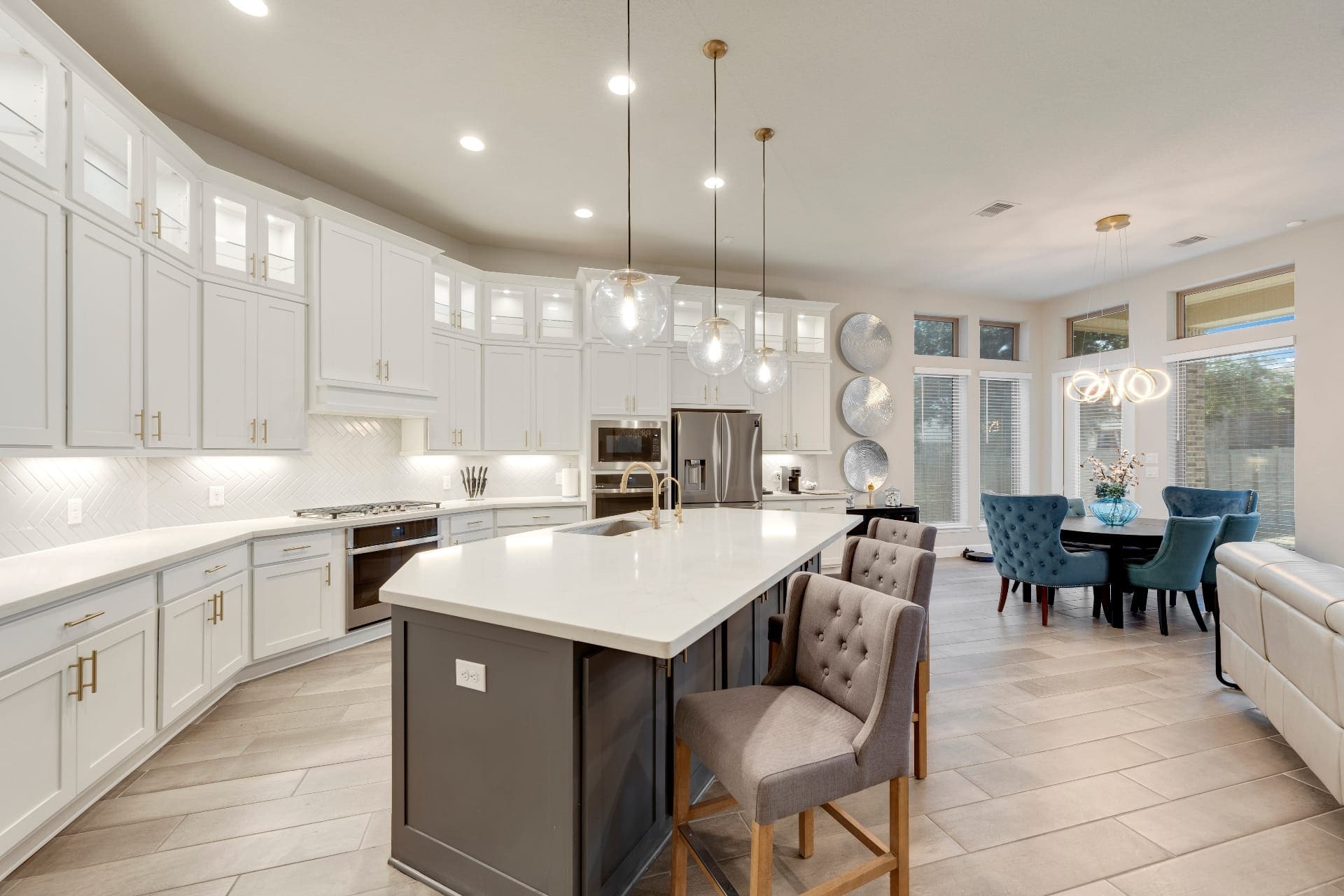
To make a small Philadelphia rowhome kitchen feel larger, focus on vertical storage to the ceiling, a smart galley or one-wall layout, light reflective finishes, paneled or integrated appliances, and removing or opening a non-load-bearing wall where possible. These five moves don't require adding square footage — they reclaim the space you already have and make the room feel intentionally designed rather than cramped.
Why Rowhome Kitchens Are a Unique Challenge
Philadelphia rowhomes — the classic 12–16 foot wide homes in South Philly, Fishtown, Northern Liberties, Passyunk, and Kensington — were built in the 1800s and early 1900s with kitchens as utility spaces, not gathering places. That creates three predictable constraints:
Narrow galleys, usually 8–10 feet wide. Two counters and a walkway is the maximum configuration. Every inch of depth and height matters.
Original plumbing in fixed locations. The stack often runs through an exterior wall or a shared party wall, which limits where you can move the sink or add a dishwasher without major replumbing.
Walls that may be structural. The party walls between rowhomes and interior load-bearing walls are structural by definition. Removing a wall without an engineer's letter and proper permitting is dangerous and illegal in Philadelphia.
These constraints don't mean you can't have a beautiful, functional kitchen. They mean the design has to be smarter — and the contractor has to understand rowhome construction before swinging a hammer.
Best Layouts for Small Kitchens
Most small Philadelphia kitchens fall into one of three layouts. Each has a best-use case:
| Layout | Best For | Pros | Cons |
|---|---|---|---|
| Galley | Narrow rowhomes, 1-cook households | Maximum counter space per square foot; efficient work triangle | Tight for multiple people; can feel tunnel-like without light |
| L-Shape | Slightly wider rooms, corner spaces | Opens one wall for seating or pass-through; better flow | Corner cabinets can be awkward without pull-out solutions |
| One-Wall | Very small spaces, open-concept conversions | Frees floor space for an island or dining table; lowest cost | Limited counter and storage; requires vertical storage strategy |
The galley is the default for a reason. In a 10-foot-wide kitchen, two 24-inch counters with a 36-inch aisle is the sweet spot. Anything wider and you lose floor space; anything narrower and two people can't pass.
The L-shape works when you can borrow space. If the kitchen sits at the back of the house and one wall opens to a dining room, an L-shape with a small peninsula creates a natural transition between cooking and living space.
The one-wall layout is underrated. Removing the second counter run and consolidating everything to one wall — with a freestanding island or dining table in the middle — can make a small kitchen feel dramatically larger. It requires the best vertical storage solution you can afford.
Storage Moves That Win Back Space
In a small kitchen, storage isn't a luxury — it's survival. These are the moves that actually add usable volume:
Ceiling-height cabinetry. Standard cabinets stop at 84 inches. Taking them to 96 inches or 108 inches adds 20–30% more storage for items you use seasonally. In a rowhome with 9–10 foot ceilings, this is the most underused opportunity.
Pull-out drawers instead of doors. A base cabinet with a door and a single shelf wastes 40% of its depth. Converting to full-extension pull-out drawers gives you access to the entire cabinet depth. For small kitchens, this is transformative.
Toe-kick drawers. The 4-inch space under your base cabinets is dead space in most kitchens. Adding shallow toe-kick drawers gives you storage for baking sheets, placemats, or pet bowls without stealing floor space.
Corner solutions. Blind corner cabinets are space graveyards. A LeMans corner pull-out or a magic corner unit turns that dead zone into functional storage. The hardware costs more, but in a small kitchen it's worth it.
Open shelving where it makes sense. One or two open shelves above a prep area or coffee station keeps daily items accessible and visually light. Too much open shelving looks cluttered; two well-placed shelves look intentional.
Appliance garages and appliance drawers. Hiding the toaster, coffee maker, and blender behind a lift-up door or in a drawer keeps counters clear. A clear counter makes a small kitchen feel 20% larger instantly.
Design Tricks That Make a Kitchen Feel Bigger
These are the visual and lighting moves that change perception without changing square footage:
Light colors on every surface. White, off-white, pale grey, and soft cream reflect more light than dark tones. In a narrow galley, light upper cabinets with a slightly darker base create depth without closing the space in.
Under-cabinet lighting. A small kitchen with a single ceiling fixture is a cave. LED strip lighting under every upper cabinet illuminates the work surface and bounces light off the backsplash, doubling the perceived brightness. It's inexpensive and high-impact.
Large-format tile with minimal grout. Subway tile is classic, but in a small kitchen the grid of grout lines creates visual noise. Large-format tile (12x24 or 24x48) with a matching grout color simplifies the wall and makes the room feel less busy.
Paneled or integrated appliances. A standard stainless steel refrigerator breaks the visual line of the cabinetry. A paneled refrigerator that matches the cabinets, or a counter-depth model that sits flush, makes the kitchen feel like one continuous surface rather than a collection of boxes.
Glass cabinet doors or open backsplashes. One glass-front upper cabinet reflects light and creates depth. A mirrored or glossy backsplash does the same thing on a larger scale.
Consistent flooring. Running the same flooring from the kitchen into the adjacent dining or living space removes a visual boundary and makes both rooms feel larger. Changing flooring at the doorway chops the space in half psychologically.
When Opening a Wall Is Worth It (and When It Isn't)
Removing a wall between the kitchen and dining room is the single most dramatic change you can make in a rowhome. But it's not always possible, and it's never cheap.
When it works: The wall is non-load-bearing and doesn't contain a plumbing stack You have another exit route from the dining room (Philadelphia fire code matters) The adjoining room has natural light that the kitchen lacks You're committed to the cost and timeline of structural engineering, permits, and beam installation
When it doesn't work: The wall is load-bearing or a party wall — these cannot be removed without major structural intervention The wall contains the main plumbing stack for the house — moving it requires re-venting and often isn't worth the cost in a single kitchen remodel You're in a historic district with exterior-facing constraints Your budget is tight — a wall removal with proper permitting and beam installation typically adds $5,000–$15,000 to a kitchen project
The middle ground: A cased opening or a wide archway. You don't get full open concept, but you gain sightlines, light, and conversation flow without the structural complexity of a full removal. It's often the best compromise in a Philadelphia rowhome.
At Icon Remodeling, we assess wall structure before we quote. If a wall is removable, we bring in a structural engineer, file the permit with Philadelphia L&I, and install the beam to code. If it's not removable, we design around it — because a smart design beats a bad structural decision every time.
Frequently Asked Questions
How much does a small kitchen remodel cost in Philadelphia? A small rowhome kitchen remodel in Philadelphia typically runs $25,000–$45,000 for a mid-range renovation with semi-custom cabinetry, quartz countertops, new appliances, and updated lighting. High-end small kitchens with custom cabinets and premium finishes can reach $50,000–$65,000.
Can you remove a wall in a Philadelphia rowhome? Sometimes. Party walls and load-bearing walls cannot be removed. Interior non-load-bearing walls can be removed with proper structural engineering, permitting through Philadelphia L&I, and beam installation. A qualified contractor evaluates this before quoting.
What's the best cabinet color for a small kitchen? Light colors — white, off-white, pale grey, or cream — reflect more light and make the space feel larger. Two-tone schemes (light uppers, slightly darker lowers) add depth without closing the room in.
How long does a small kitchen remodel take? Plan for 4–8 weeks of on-site work for a small kitchen, plus 2–4 weeks of design and material selection. Custom cabinetry lead times are usually the longest variable — 4–8 weeks from order to delivery.
Ready to Maximize Your Small Kitchen?
Small kitchens don't have to feel small. With the right layout, storage strategy, and light, a narrow Philadelphia rowhome kitchen can function like a much larger space.
Icon Remodeling specializes in [kitchen remodeling](/services) for Philadelphia rowhomes and Main Line homes. See our [Philadelphia kitchen remodeling page](/philadelphia-kitchen-remodeling) for local project examples, or read our [kitchen remodel cost guide](/blog/kitchen-remodel-cost-philadelphia-2025) for realistic budgeting.
When you're ready to talk through your space, [request a free estimate](/free-estimate) or call (215) 918-8010. We serve Philadelphia neighborhoods including Fishtown, Northern Liberties, South Philly, Passyunk, Manayunk, and Chestnut Hill, as well as Main Line communities from Ardmore to Villanova.